

This review first appeared in the ARSC Journal (of the Association for Recorded Sound Collections), 2013;44(1):159-162, and is reprinted with the permission of the author, James Fisher, and the publisher of the ARSC Journal. For information about ARSC, see www.ARSC-audio.org.
Judy Garland: The Historic Carnegie Hall Concert Remastered.
For the First time in the Original Mono. JSP Records. JSP4232. 2 compact discs.


Endless fascination with Judy Garland’s life and career, both the world’s and my own, and the ever-growing appreciation of her extraordinary vocal prowess have led to heightened interest in her recorded legacy in recent years.
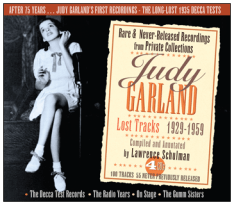

All of Garland’s known studio recordings are currently available in the compact disc format, with outtakes and alternate takes, and previously “lost” recordings appearing with frequency as part of new releases. JSP Records has led the way in preserving Garland’s vocal achievement in the past few years under the guidance of Lawrence Schulman, a Garland scholar and sound archivist extraordinaire. In preserving Garland’s recorded legacy, JSP and Schulman have not limited themselves to her studio recordings but have delved deeply into rare soundtrack, radio, studio, and live concert recordings. Thanks to their efforts, confirmed “Garlandites” have burgeoning libraries of Garland recordings. These include the earliest known vocals in Warner Bros./Vitaphone “talkie” short subjects from 1929-1930 with seven-year-old Garland as the youngest member of the Gumm Sisters, as well as “lost” and now found recordings, such as two of her three unreleased 1935 Decca Records tracks – one remains lost – that recently appeared on JSP and Schulman’s four-disc Judy Garland: Lost Tracks 1929-1959. Beyond these early recordings, Garland’s work in commercial recording studios, on movie sound stages, on radio and television, and in concert spread across her too-short life up to her last European appearances in London and Scandinavia in the weeks preceding her June 1969 death.


As previously noted, Judy at Carnegie Hall has been re-released non-stop since its first appearance over fifty years ago. First released on compact disc in 1989, in stereo, it has since undergone some transformations, including a 2000 “gold” version released by DCC Compact Classics in which every second of the concert’s master tapes housed in its vaults was presented, without editing, from start to finish. The DCC set was followed in 2001 by another Capitol Records release, this too complete and with some reverb added compared to the DCC mastering. These two releases reaped no new songs since all of Garland’s vocals that night were included on the original album, but it added some stage waits and Garland quips and stories between numbers, including a hilarious account of a visit to a Parisian hairdresser during a European tour, as well as her touching introduction of songwriter Harold Arlen, a perfect gesture given that her program featured many Arlen compositions (he was only one of a number of celebrities present in the star-studded audience). Garlandites welcomed the DCC set as well as the Capitol, which was released just prior to the fortieth anniversary of the concert. But despite the aforementioned minor additional pleasures, some listeners (including this one) have missed both the original mono sound and the added intensity resulting from the original version’s relatively minor audio edits, which increased the momentum of Garland’s performance.

Most of us in the “baby boom” generation (and after) were introduced to Garland in childhood viewings The Wizard of Oz (1939) during its annual holiday television showings, in my case during the 1950s and early 1960s. Little did we imagine that Dorothy Gale of Kansas grew up to be one of the singular entertainers of the Twentieth Century, and we ultimately discovered a wholly different Garland. Though her film work slowed after 1950 to a few notable appearances (most particularly A Star Is Born in 1954), in those days before home video we could only see her in old films on TV, her appearances on TV variety and talk shows, most effectively in a few specials and on The Judy Garland Show, her 1963-64 television series. Otherwise, in those days, experiencing Garland could only happen in person and through recordings. I was fortunate enough to see Garland on stage twice in June 1968 at the Garden State Arts Center in New Jersey – and the experience was unforgettable. The best of her concert and television recordings go some distance in capturing the experience I had of seeing her live because, it must be stressed, there was always a special vitality in her vocalizing before a live audience that was not present in even the best of her commercial or film soundtrack recordings.
For us “boomers,” Judy at Carnegie Hall was released during our adolescence – and that extraordinary mono album is the way we like to remember it and her. My parents owned the album and I played it until it was worn-out and replaced – more than once. As technology changed with stereo LP versions and stereo compact discs offerings of Judy at Carnegie Hall, I moved with the times but continued to miss the unique vitality of the original mono release. As such, Judy Garland: The Historic Carnegie Hall Concert Remastered, preserved by London-based JSP Records on two-CDs as a restoration of the original LP album, which has now hit public domain outside the U.S, and presented in glorious mono, impressively restores the original experience and very happy memories.
Garland’s Herculean performance at Carnegie Hall became the stuff of legend and, remarkably, the recorded evidence only supports and enhances that legend. The concert has been written about profusely, and the qualities of her voice, which undeniably had changed since her cinematic heyday, have been widely debated by critics and scholars. However, any imperfections in her voice or in technical areas, which it must be noted are inherently imperfect for that period, are moot. The overall result in Judy at Carnegie Hall is, by any standard, impressive on all counts, and this JSP restoration proves it. Garland was at her latter-day best and the original recording quality is remarkable – and is best heard in mono.


Garland sang a total of 25 songs that night, including encores and not counting separate songs featured in medley form, such as her famous threesome medley of “You Made Me Love You,” “For Me and My Gal,” and “The Trolley Song,” reminding listeners of her early musical films. The program presents Garland in every conceivable mood; and this fact is, perhaps, a clue to her extraordinary impact on an audience. She shifts moods from exuberance to the depths of despair in a nano-second; each song becomes something like a mini-comedy or one-act drama exploring the various faces of love, loss, absurdity of existence, and other human emotions. At once bombastic (“Come Rain or Come Shine”), comic (“San Francisco,” “When You’re Smiling”), introspective (“Alone Together”), nostalgic (“After You’ve Gone”), and profoundly autobiographical (“The Man That Got Away,” “Over the Rainbow”), Garland rewards listeners with a survey of American popular music of the early and mid-Twentieth Century, and it presents a compendium of her own career highs. Garland’s orchestra, under the direction of her longtime conductor, Mort Lindsey, is in especially fine fettle from the start of the famous Garland overture to the final playoff, and of course Garland is consistently at her unmatchable best throughout.


Any true Garlandite will want the DCC “gold” version or the Capitol follow-up of the complete concert as it happened, and as a companion, this fine restoration of the first-released slightly edited LP version. The relatively minor edits and rearrangements made for the original release and honored here provide an even more exciting listening experience than the DCC or Capitol versions. For those of us raised on the Judy at Carnegie Hall LP, it is digital heaven, and we can only envy those hearing this concert for the first time via this outstanding JSP Records release. The remastering for this JSP release is expert, and the overall audio experience here is excellent, especially in eliminating the muddiness evident on the first compact disc release in 1989, which was stereo. JSP’s packaging eschews the original Judy at Carnegie Hall poster cover art and instead features a reproduction of an actual ticket to the concert, which is repeated on the cover of the two jewel boxes containing the discs, which are also adorned with photos of Garland. All in all, JSP Records has provided another gem for audiophiles and Garlandites alike (“boomers” or otherwise) – and one can only look forward to its next Garland project.
James Fisher
The University of North Carolina at Greensboro
More information about Judy Garland’s recordings can be found at
The Judy Garland Online Discography
.